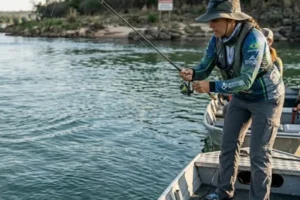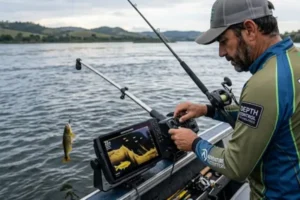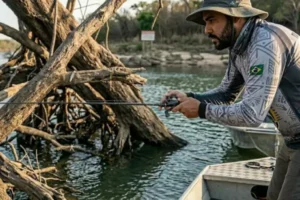
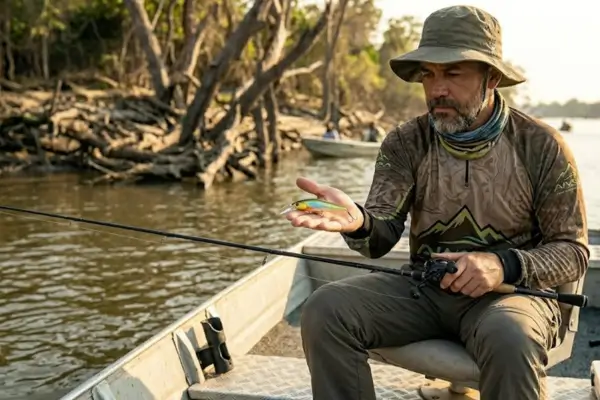
Working mid-depth lures is one of the most efficient strategies for fishing in rivers where fish remain active in intermediate layers of the water column. In many environments, fish are positioned neither close to the bottom nor directly on the surface, requiring more balanced presentations and constant depth control.
In these situations, fishing success depends on the angler’s ability to keep the lure within the zone where fish are actively moving. Small changes in depth, retrieval speed, or lure rhythm can completely alter fish response during the presentation.
In addition, factors such as current, submerged structures, water temperature, and light conditions directly influence fish positioning throughout the day.
For this reason, developing control over mid-depth lure presentations allows anglers to create more natural, efficient, and adaptable fishing approaches in different environments.
Fish Distribution in Intermediate Water Layers
Fish positioned in intermediate layers often use specific areas of the water column for feeding and movement.
This behavior changes according to environmental characteristics, current intensity, and natural food availability.
In many rivers, intermediate layers provide a balance between comfortable water conditions, current circulation, and movement efficiency.
Areas near submerged structures also frequently concentrate fish within this depth range.
Understanding how these species use the environment greatly improves lure presentation strategy.
Defining the Ideal Depth for Lure Presentation
Finding the correct depth is one of the most important factors when working mid-depth lures.
Even small differences in lure positioning can significantly influence fish behavior.
For this reason, anglers should continuously observe fish response during the first few casts.
Changes in retrieval timing, lure sink rate, and pause duration help identify the most productive depth range.
Adjusting depth according to observed reactions greatly improves presentation efficiency.
Retrieval Control to Keep the Lure in the Active Zone
Retrieval must be carefully controlled to keep the lure within the desired water layer.
Very fast retrieves may raise the lure excessively, while overly slow retrieves may allow it to sink below the active zone.
Finding a balanced rhythm is therefore essential for maintaining presentation stability.
In addition, maintaining consistency during the retrieve helps create more natural lure movement in the water.
This control significantly improves efficiency in productive areas.
Using Pauses to Explore Different Water Layers
Pauses are extremely effective when working mid-depth lures.
Temporarily interrupting the retrieve allows the lure to slightly change depth and behavior within the water column.
In many situations, these changes increase fish interest from different depth levels.
Strategic pauses also help keep the lure longer within the active zone.
The ideal pause duration may vary according to fish behavior and environmental conditions.
Retrieval Rhythms to Simulate Natural Prey Movement
The rhythm applied during lure presentation directly affects how natural the movement appears.
Continuous retrieves create smoother displacement, while quick accelerations generate stronger lure action changes.
Alternating between different rhythms helps simulate prey moving naturally through the water.
Subtle speed changes also frequently stimulate quicker fish responses.
This variation makes the presentation less predictable and more efficient.
Adjusting Lure Trajectory During Retrieval
Controlling lure trajectory is essential in rivers with structures and changing current conditions.
Directional changes during the retrieve allow anglers to explore different angles within intermediate water layers.
Small rod position adjustments also help keep the lure away from obstacles and inside the desired strike zone.
Trajectory control further improves movement naturalness throughout the presentation.
Reading Subtle Line Reactions for Quick Adjustments
Not all fish responses are immediately obvious.
In many situations, small changes in line tension or subtle vibrations indicate fish approaches or light contacts.
For this reason, maintaining constant attention to the line greatly helps with making quick adjustments during the retrieve.
These signals allow anglers to modify speed, depth, and rhythm according to fish behavior.
The better this interpretation becomes, the greater the overall presentation efficiency tends to be.
Influence of River Structure on Fish Positioning
River structure directly influences fish positioning in intermediate water layers.
Submerged branches, rocks, drop-offs, and current variations create highly productive holding areas.
In many cases, fish use these areas as movement corridors and feeding zones.
Presenting the lure near these structures significantly increases fishing efficiency.
Understanding how water flows around obstacles also greatly improves lure positioning.
Alternating Speed to Stimulate Fish Response
Changing retrieval speed during the presentation is a highly effective mid-depth fishing technique.
Gradual rhythm changes create variations in lure behavior and increase presentation visibility.
In many situations, short accelerations followed by slower retrieves produce highly positive fish responses.
This alternation also helps quickly identify the most efficient movement pattern for current conditions.
Influence of Current on Lure Presentation
River current directly affects mid-depth lure behavior.
In areas with stronger water flow, the lure may rise or change trajectory more easily.
For this reason, controlling retrieval speed and rod position becomes even more important.
Adapting the presentation according to current intensity greatly improves lure stability.
Equipment Adjustments for Better Control
The equipment used significantly influences mid-depth lure performance.
More sensitive rods improve perception of vibrations and subtle lure contacts.
Proper line selection helps maintain consistent depth and trajectory control.
Balanced baitcasting reels and spinning reels also allow more precise speed adjustments.
A well-balanced setup greatly improves presentation quality.
Importance of Casting Accuracy
Casting accuracy is also fundamental when working mid-depth lures.
Properly positioning the lure near structures and fish movement corridors greatly increases fishing efficiency.
Accurate casts also reduce the need for excessive corrections during the retrieve.
The better the initial lure placement, the greater the effectiveness within the active zone.
Common Mistakes When Working Mid-Depth Lures
Some mistakes greatly reduce presentation efficiency:
- Retrieving at the same speed continuously
- Ignoring subtle line changes
- Failing to vary lure depth during the session
- Retrieving excessively fast
- Fishing too far from productive structures
- Failing to use strategic pauses
Avoiding these mistakes significantly improves presentation consistency.
Working mid-depth lures in rivers with fish positioned in intermediate water layers requires control, observation, and constant adaptation.
The combination of proper depth adjustment, retrieval control, rhythm variation, and reaction interpretation allows anglers to create much more efficient presentations.
In addition, understanding the influence of structures and current helps position the lure more strategically throughout the fishing session.
With practice and continuous refinement, anglers develop greater control over lure behavior and significantly improve fishing performance in different river environments.